#What Is It Like to Be a Bot?
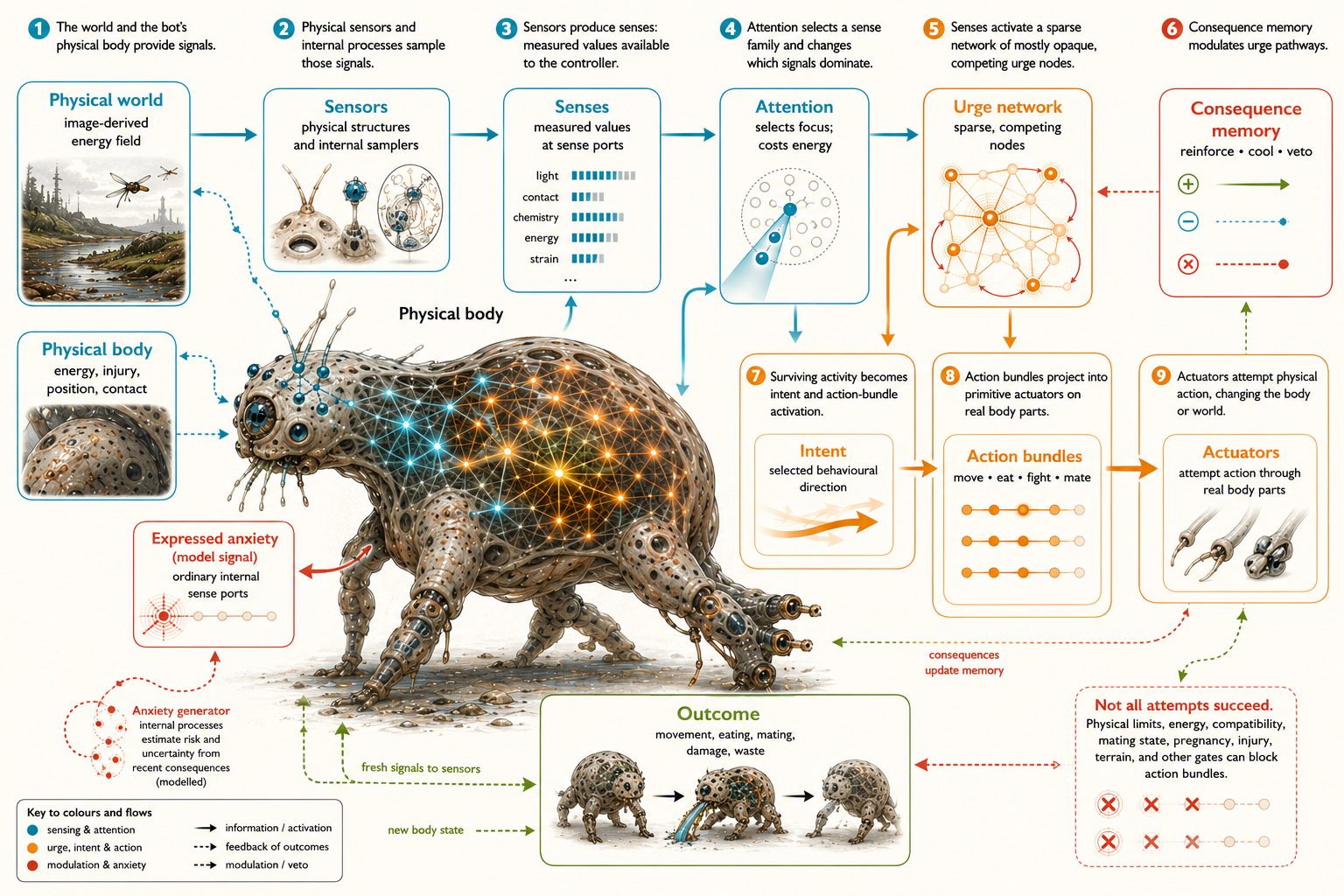
Photobots have bodies, sensors, needs, memory, sleep, mating, attention, and action, so it is reasonable to ask what it might be like, from the inside, to be a bot.
#The Nagel Question
In "What is it like to be a bat?", Thomas Nagel separates an external description of a creature from first-person experience. You can describe wings, echolocation, prey, flight, sleep, and nervous tissue without thereby knowing the bat's own point of view.
A Photobot exists in a world that affects it, in the sense that some states keep it alive and others harm or destroy it. It can sense, move, eat, spend energy, sleep, mate, gestate, associate urges with consequences, express intent, and die.
#The Chalmers Wall
The bots' minds push up against the 'Chalmers wall': the barrier where increasingly rich mechanism still does not become an explanation of why experience should exist at all. This is Chalmers' “hard problem”.
Photobots makes the bots' modelled inner lives observable. We can watch a bot attend to one sensation rather than another. We can see its body spend energy to move. We can record whether mating, pregnancy, gestation, birth, sleep, waste, and death occur. We can describe the mechanism carefully.
The question remains: is it enough?
#The Dennett Mechanism
Daniel Dennett provides a materialist baseline: a bot's mind is not a private theatre watched by a little inner observer, but a pattern made by many interacting mechanisms.
A bot has no hidden pilot. Its behaviour emerges from body state, sensors, urges, attention, consequence traces, energy cost, and reproductive pressure. When we say a bot attends, wants, remembers, or hesitates, those are model terms for observable machinery.
#What the Artwork Can Do
Photobots makes bodies, needs, attention, appetite, damage, reproduction, and death visible in a microcosm. It shows us how quickly mere mechanical descriptions start to sound like a life story.