#What is Photobots?
Photobots is an artwork by Dave Sag.
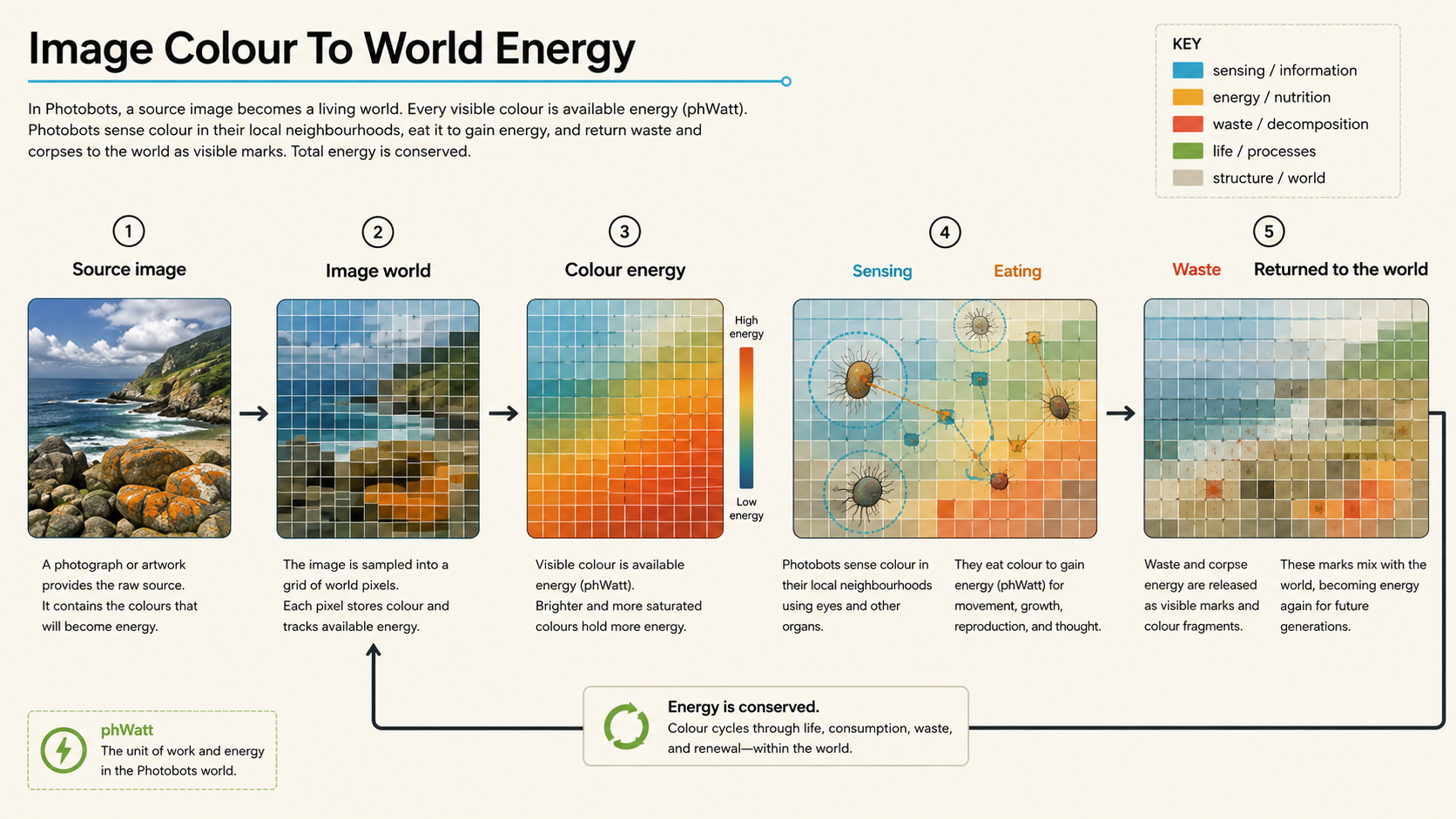
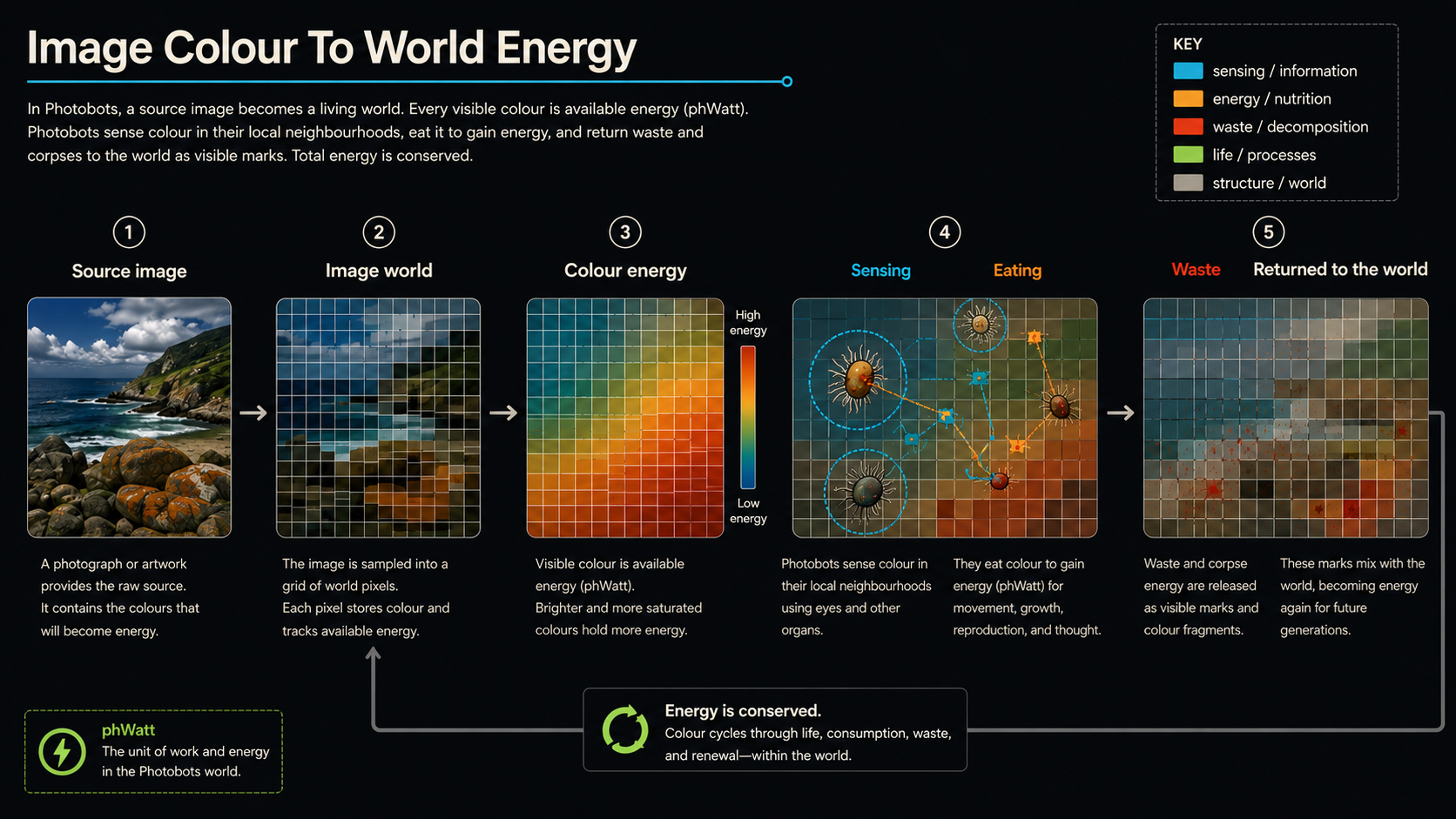
The Photobots’ observable world is an energy field deterministically created from an image you supply. The visible colour in the image becomes a skein of available energy. The Photobots live inside that world. What they can sense and eat depends on the sensors on their bodies and many other genetically expressed attributes. Once they have digested the colour, they absorb what energy they can, spend some on moving and thinking, excrete waste, and, finally, decay into the energy field when they die. They leave the original image fundamentally changed by their passage.
Photobots is a simulation.
The Photobots’ world is derived from the image supplied to them. Brightness, hue, location, and local structure make different regions easier or harder to live in. A garden, a face, a city, a flag, or a flat colour field become different ecologies.
Colour, in the simulated world, becomes available energy measured in phWatt
(photo watt). Bots must ingest colour energy to survive. When they do, they
break it down into different energy stores. They gradually spend it on
thinking, taking action, and their own physiology. The process is inherently
inefficient, and waste energy is deposited back into the image. When a bot
dies, its body’s stored energy dissolves back into the base image over time.
#Painting With Philosophy
Photobots implements a broad cross-section of ideas from artificial intelligence, theories of mind, and embodied life. It wraps them in plausible mechanics. Each bot has a genetically expressed weighted network of senses, urges, and actuators that make up its brain. It includes models of attention, anxiety, joy, contentment, sleep, dream-like replay, appetite, damage, and injury. Higher-order behaviours like selective eating, or mating and reproduction, emerge as evolution grinds out more and more capable bots.
Most of what Photobots currently models aligns with Daniel Dennett's view of mind: intelligence and awareness-like behaviour arise from interacting mechanisms, not from a hidden little observer inside the creature, and no such observer is modelled in the bots.
The visible output is a conflict between the source image, the current world parameters, the bots' DNA, and the pressure of survival. Each run is deterministic for a given seed and configuration, but the patterns can still be surprising because many small embodied decisions accumulate over a long time.
#The Chalmers Wall
A Photobot can have a body, needs, local perception, internal state, consequence memory, and a history of action without that being the same question as “what is it like to be it?” The project presses on what I call the Chalmers wall: the hard boundary between an externally described mechanism and first-person experience.
Photobots seeks to make that mechanism visible and asks where explanations stop feeling complete.
#First Public Guide
This first public guide is deliberately small:
Later public pages may expand colour physiology, DNA, evolution, urges, attention, installation sketches, and a fuller glossary.