Garden - by Dave Sag
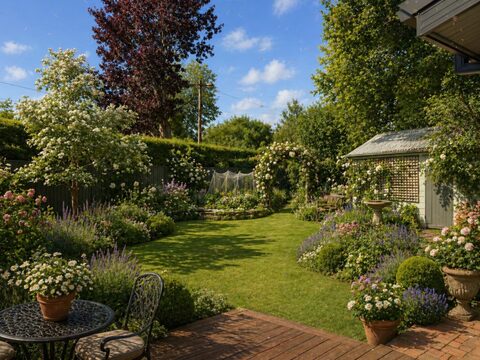
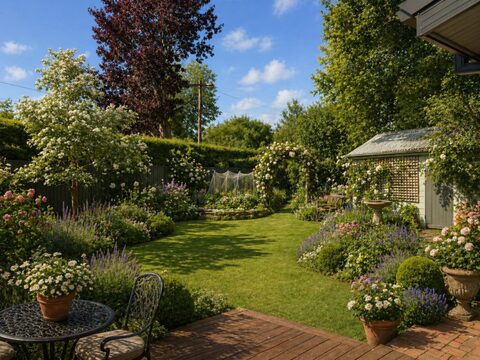
This pair shows the same peaceful garden before and after a Photobots simulation. The first image is the untouched scene; the second records the surface after the simulation has run, preserving only the accumulated patina and the bodies of bots that have died.
The full-resolution comparison could not be loaded; the thumbnails remain available.
Original
A neatly maintained garden opens from a timber deck onto a broad lawn bordered by dense flower beds. A white-flowering tree, clipped hedges, climbing roses, a small garden shed, birdbath, and potted daisies frame the view beneath a bright blue sky with scattered clouds.
Patina
At first glance the composition appears almost unchanged, but close inspection reveals countless tiny marks scattered across the image. Fine specks, faint trails and small clustered traces are visible against the sky, lawn, paving, shed and foliage, subtly altering the surface while leaving the overall garden intact.
What changed
Rather than reshaping the scene, the simulation leaves a delicate layer of distributed traces across the image. These marks form the garden’s patina: the visible record of countless local interactions, together with the bodies of Photobots that did not survive to the moment of capture.
In just under 8 simulated seconds, an initial population of 500 Photobots produced this patina; 451 had died by the time it was captured, with 49 still alive. The survivors were omitted from the final image.
Details
Gallery material is curated and intended for a general audience.
- Iteration
- 1000
- Elapsed in iteration
- 7.6 s
- Seeded into iteration
- 500
- Matured through capture
- 253
- Born through capture
- 0
- Dead through capture
- 451
- Alive at capture
- 49
- Deepest living biological generation
- 0